
- Posted on
- AI Accelera
- No Comments
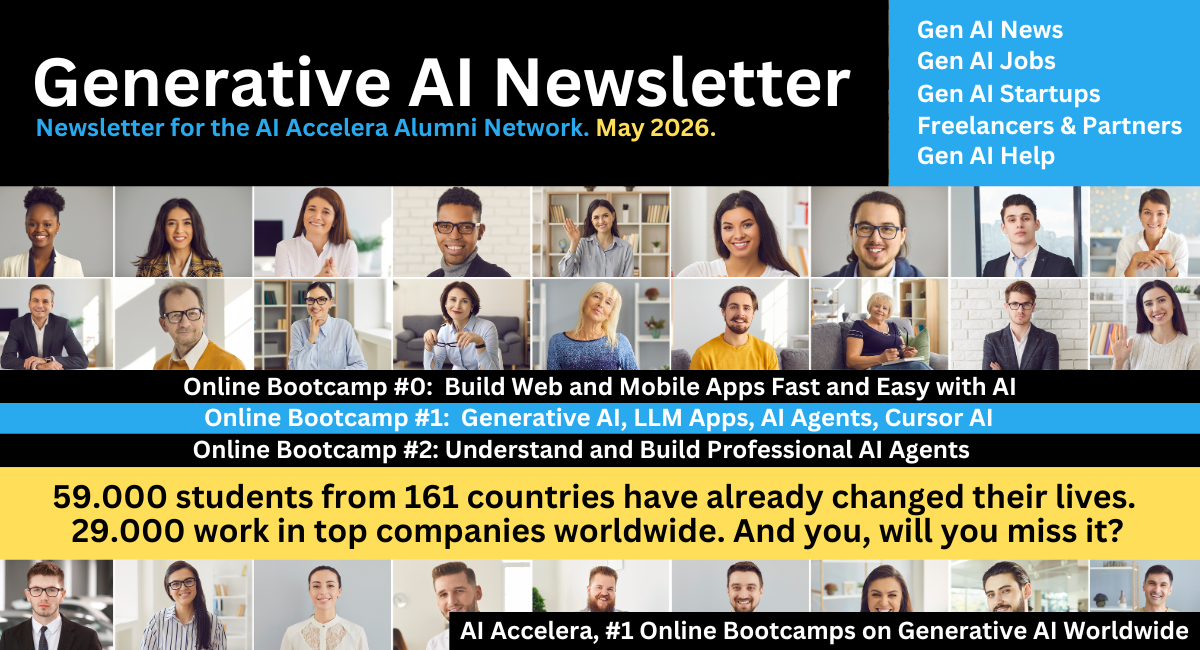
The newsletter of the Alumni Network of AI Accelera this month includes the following content:
- Selection of news.
- Job offers.
- Opportunities in startups.
- Opportunities for freelancers and partners, both technical and commercial.
- Support for introducing Generative AI in your company.
SELECTION OF NEWS
Latest data from the student and business community.
Being part of the student and business community of AI Accelera has great value: more than 29,000 of our students work at the world’s leading companies.
During the past month of April, we surpassed 59,000 students in 161 countries and were contacted by companies from all over the world seeking help to introduce Generative AI into their businesses.
Video: This is AGI: Sequoia AI Ascent 2026 Keynote
https://youtu.be/LRo33rnv6rQ?si=Qf3qaxCxdqatd8dJ
The video argues that we are entering a new technological era driven by artificial intelligence, comparable to or even larger than past revolutions like the internet, where AI is evolving from simple tools into autonomous “agents” that can perform complex tasks, collaborate, and even replace entire workflows; the speakers (from Sequoia Capital) explain how this shift is transforming how software is built—from static applications to dynamic, AI-powered systems—creating massive opportunities for startups and reshaping industries, while also emphasizing that value will increasingly move toward those who control data, distribution, and user relationships, and that the biggest winners will be companies that successfully integrate AI into real-world use cases rather than just building models themselves.
Video: OpenAI’s Greg Brockman: Why Human Attention Is the New Bottleneck
https://youtu.be/bBS93A0BeNI?si=fG-tU8xQwImxKPzK
In this talk, Greg Brockman explains that as AI systems rapidly advance—now capable of generating a large share of code and handling increasingly complex tasks—the real constraint is no longer compute or model capability but human attention, which becomes the scarce resource needed to guide, review, and take responsibility for AI outputs; he argues that we are approaching advanced AI (with some estimates putting progress toward AGI surprisingly far along), where humans shift from doing work to supervising fleets of AI agents, making judgment, taste, and decision-making the most valuable skills, while emphasizing that despite high automation, humans remain accountable for outcomes and must design systems that effectively manage, coordinate, and align these powerful tools with real-world goals.
Video: Anthropic’s Boris Cherny: Why Coding Is Solved, and What Comes Next
https://youtu.be/SlGRN8jh2RI?si=TBE1UuTKrqFftCTo
In this video, the speaker argues that as AI becomes increasingly capable of performing technical tasks like coding, writing, and analysis, the most valuable human skill is shifting away from execution toward clear thinking, taste, and problem selection, meaning that success will depend less on how well you can do the work yourself and more on how well you can define what should be done, evaluate outputs, and guide AI systems effectively; the talk emphasizes that many people mistakenly focus on learning tools or prompts, while the real leverage comes from developing judgment, curiosity, and the ability to ask the right questions, since AI dramatically amplifies these traits, ultimately suggesting that individuals who combine domain understanding with strong decision-making and direction-setting will outperform those who rely purely on technical ability in an AI-driven world.
Video: Andrej Karpathy: From Vibe Coding to Agentic Engineering
https://youtu.be/96jN2OCOfLs?si=h-Obtv29d77xakH4
In this talk, Andrej Karpathy explains that software development is undergoing a fundamental shift into what he calls “Software 3.0,” where programming moves from writing code to orchestrating large language models through prompts and context, enabling a new style of “vibe coding” in which developers increasingly trust AI to generate working solutions with minimal intervention; however, he emphasizes that this comes with a crucial transition toward “agentic engineering,” where professionals must still ensure reliability, security, and quality when coordinating AI agents at scale, while also highlighting that AI exhibits “jagged intelligence”—being extremely powerful in verifiable domains like code and math but unreliable in ambiguous reasoning—meaning the biggest opportunities lie in tasks that can be objectively evaluated, and the key human role shifts toward judgment, system design, and understanding, since although thinking can be partially outsourced to AI, true comprehension and responsibility cannot.
Video: Demis Hassabis: We’re Three Quarters of the Way to AGI
https://youtu.be/AFpeWo1GTeg?si=of-aLa0B3-ur7gHN
In this talk, Demis Hassabis argues that the AI field is now roughly 75% of the way toward Artificial General Intelligence (AGI), with recent progress driven largely by scaling large models, but emphasizes that key breakthroughs are still needed in areas like reasoning, planning, consistency, and continual learning before true human-level intelligence is achieved; he explains that current systems show “jagged intelligence”—excelling in some domains while failing in simple ones—and highlights that the next phase will likely involve combining today’s language models with “world models” that better understand and simulate reality, enabling AI to reason about the physical world and drive major scientific discoveries (e.g., in medicine, energy, and materials), while stressing that although AGI could arrive within the next 5–10 years, it must be developed carefully with strong safety, governance, and global coordination due to its potentially transformative—and disruptive—impact on society.
JOB OPPORTUNITIES
The demand for talent in Generative AI continues to grow exponentially. See Lessons 70 and 71 of Bootcamp #1 (or 45 and 46 of Bootcamp #2) to explore job opportunities and tips on how to take advantage of them. On platforms like this, you can find some of the best job offers in this field, initially focused on positions available in San Francisco. For those interested in other locations, the search tool can help you find the perfect opportunity in your preferred geographic area. Don’t forget that the most common opportunities are the so-called “hybrid” ones in Lesson 70.
OPPORTUNITIES IN STARTUPS
We continue to see a great boom in the creation of Generative AI startups. See Lessons 74, 75, and 76 of Bootcamp #1 (or 49, 50, and 51 of Bootcamp #2) to learn about opportunities and tips on how to take advantage of them.
OPPORTUNITIES FOR FREELANCERS AND PARTNERS, BOTH TECHNICAL AND COMMERCIAL
The demand for talent in Generative AI continues to grow. On platforms like this, you can find some of the best freelance opportunities in this field, initially focused on remote positions.
SUPPORT FOR INTRODUCING GENERATIVE AI IN YOUR COMPANY
For those thinking of introducing Generative AI in their company, in the Bonus section of the Bootcamp (the last one) we show how we can help you from AI Accelera.
If you are interested in learning more about how to apply Generative AI in your company, here are some interesting links: