
- Posted on
- AI Accelera
- No Comments
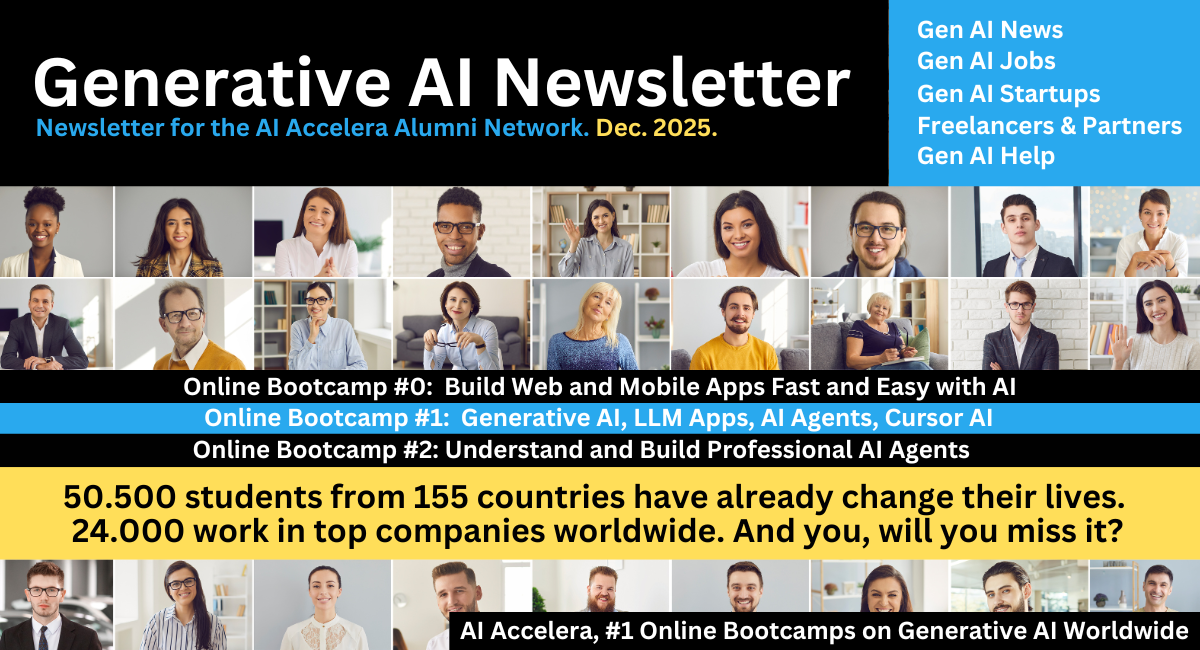
The newsletter of the Alumni Network of the AI Accelera this month includes the following content:
- Selection of news.
- Job offers.
- Opportunities in startups.
- Opportunities for freelancers and partners, both technical and commercial.
- Support for introducing Generative AI in your company.
SELECTION OF NEWS
Latest data from the student and company community.
Being part of the student and company community of the AI Accelera has great value: more than 24,000 of our students work at the world’s leading companies.
During the past month of November, we surpassed 50,500 students in 155 countries and were contacted by companies from all over the world seeking help to introduce Generative AI into their businesses.
Video: AI Future with Elon Musk (Tesla) and Jensen Huang (Nvidia)
https://youtu.be/I9TxUsibexQ
The video captures a high-profile panel between Abdullah Alswaha, Elon Musk and Jensen Huang, in which they discuss a sweeping vision for the “intelligence age.” They outline a major shift: countries like Saudi Arabia and the U.S. are teaming to build enormous AI infrastructure — data centers, “AI factories,” and robotics — with the aim to transform economies and make work optional rather than obligatory. Musk predicts that humanoid robots will become humanity’s most important product, surpassing cars and smartphones, potentially leading to a society of abundance. Huang adds nuance, arguing that even if labor becomes “optional,” AI could make us busier — freeing time for creative and meaningful work rather than menial tasks. The panel paints a future where generative AI, robotics, and massive compute redefine global productivity, industry, and the nature of human work.
Video: AI is Eating Logistics (Ryan Petersen, CEO of Flexport)
https://youtu.be/KTmxaMdUbHA
In this video, Ryan Petersen describes how AI is transforming global logistics. He argues that by automating freight-forwarding tasks, AI could make ocean-container shipping 8–10% cheaper over the next few years, largely by reducing labor costs. He also explains that large incumbents like Flexport benefit more from AI than startups do, because they have huge data sets, domain expertise, and broad distribution — letting them deploy AI improvements at scale across many customers. Finally, Petersen rejects the idea that AI will leave people idle; instead he suggests that people will just want more goods and services, so automation will boost demand and economic activity rather than cause widespread unemployment.
Video: AI isn’t digital transformation, and leaders need to understand why (Conor Grennan, Chief AI Architect at New York University)
https://youtu.be/eZ1NizUx9U4
The video argues that adopting AI is not the same as undergoing a broader digital-transformation, and warns organizations against treating generative AI as a magical “plug-and-play” solution. Instead, it emphasizes that real value comes when companies rethink and redesign their core workflows, processes and organizational culture — not just layering AI tools on top of old practices. The speakers highlight that many digital transformation failures stem from neglecting people, process, and change-management challenges: it’s not enough to choose a flashy AI tool; you need leadership buy-in, clear goals, new company workflows, and alignment with business strategy. In short: AI can be a powerful accelerator — but only if used as part of a holistic transformation that involves reimagining how work gets done.
Video: The Minds of Modern AI: Jensen Huang, Geoffrey Hinton, Yann LeCun & the AI Vision of the Future (FT)
https://youtu.be/0zXSrsKlm5A
The video features leading figures in artificial intelligence — including Jensen Huang, Geoffrey Hinton, Yann LeCun, Yoshua Bengio, Fei-Fei Li and Bill Dally — discussing how AI evolved from early neural-network research to today’s powerful generative-AI systems, and debating what this progress means for the future. They highlight that while modern models can outperform humans in many narrow tasks, they still lack true understanding, reasoning, and common sense, leaving human-level general intelligence an unsolved challenge. The group disagrees on how quickly AI will advance: some foresee rapid breakthroughs and sweeping economic transformation, while others urge caution about safety, ethics, and the societal upheaval that could follow. Across their perspectives, the panel underscores a central theme — AI offers extraordinary potential, but realizing it responsibly will require thoughtful governance, scientific humility, and a deep focus on human values.
Video: The Future of Consumer AI (Michael Mignano, LightSpeed)
https://youtu.be/Z4L4ZqL1xqQ
The video argues that thanks to advances in AI and large foundational models, many consumer-facing startup ideas that once seemed doomed or saturated are now viable again (“impossible until now”). It explains how generative AI enables entirely new kinds of consumer products — e.g. in music, education, personal health, self-improvement, creative tools — where automation can recreate or reinvent experiences that previously required large teams, high costs, or structural barriers. The speaker emphasizes that in this emerging landscape success depends less on incremental improvement and more on rethinking what’s possible: building products that leverage AI fundamentally, rather than just as an add-on. They also warn that for such consumer AI ideas to take off, distribution (i.e. reaching users) remains critical: no matter how powerful the tech, without smart growth and engagement strategies even good products may never scale.
JOB OPPORTUNITIES
The demand for talent in Generative AI continues to grow exponentially. See Lessons 70 and 71 of Bootcamp #1 (or 45 and 46 of Bootcamp #2) to explore job opportunities and tips on how to take advantage of them. On platforms like this, you can find some of the best job offers in this field, initially focused on positions available in San Francisco. For those interested in other locations, the search tool can help you find the perfect opportunity in your preferred geographic area. Don’t forget that the most common opportunities are the so-called “hybrid” ones in Lesson 70.
For those seeking an entry-level position, in the Bonus section of the Bootcamp (the last one) we show how we can support you from the AI Accelera.
OPPORTUNITIES IN STARTUPS
We continue to see a great boom in the creation of Generative AI startups. See Lessons 74, 75, and 76 of Bootcamp #1 (or 49, 50, and 51 of Bootcamp #2) to learn about opportunities and tips on how to take advantage of them.
For those needing help to access the startup world, in the Bonus section of the Bootcamp (the last one) we show how we can support you from the AI Accelera.
OPPORTUNITIES FOR FREELANCERS AND PARTNERS, BOTH TECHNICAL AND COMMERCIAL
The demand for talent in Generative AI continues to grow. On platforms like this, you can find some of the best freelance opportunities in this field, initially focused on remote positions.
For those seeking a role as a freelancer or partner, whether technical or commercial, in the Bonus section of the Bootcamp (the last one) we show how we can support you from the AI Accelera.
SUPPORT FOR INTRODUCING GENERATIVE AI IN YOUR COMPANY
For those needing help to introduce Generative AI in their company, in the Bonus section of the Bootcamp (the last one) we show how we can support you from the AI Accelera.
If you are interested in learning more about how to apply Generative AI in your company, here are some interesting links: