
- Posted on
- AI Accelera
- No Comments
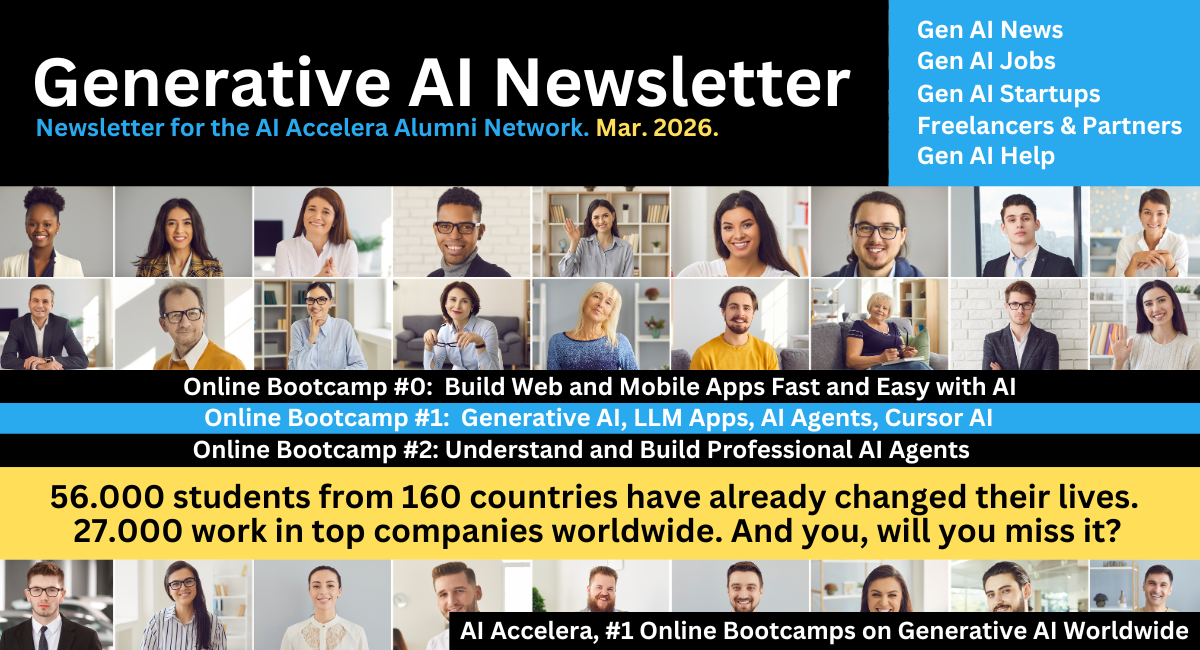
The newsletter of the Alumni Network of AI Accelera this month includes the following content:
- Selection of news.
- Job offers.
- Opportunities in startups.
- Opportunities for freelancers and partners, both technical and commercial.
- Support for introducing Generative AI in your company.
SELECTION OF NEWS
Latest data from the student and business community.
Being part of the student and business community of AI Accelera has great value: more than 27,000 of our students work at the world’s leading companies.
During the past month of February, we surpassed 56,000 students in 160 countries and were contacted by companies from all over the world seeking help to introduce Generative AI into their businesses.
Video: The AI Tsunami is Here & Society Isn’t Ready (Dario Amodei, CEO Anthropic)
https://youtu.be/68ylaeBbdsg?si=hu7LPyuwRnof4L8f
In this interview, Dario Amodei, CEO of Anthropic, tells host Nikhil Kamath that artificial intelligence is advancing so quickly that society is vastly underestimating how disruptive it will be, comparing the coming impact to an “AI tsunami.” He explains that modern AI progress follows scaling laws, where increasing data, compute, and model size reliably produces more capable intelligence, meaning human-level AI may arrive sooner than most people expect. The discussion covers Amodei’s path from biophysics to AI, Anthropic’s focus on safety and alignment, the risk of economic disruption and concentration of power in a few tech companies, and the need for better regulation and public awareness. They also explore how countries like India could play a major role in the AI ecosystem, the future of work (where human judgment and emotionally driven roles may remain valuable), and why critical thinking and responsible deployment will be essential as AI becomes a general-purpose technology reshaping industries and society.
Video: The AI Agent Economy Is Here (Y Combinator)
https://youtu.be/Q8wVMdwhlh4?si=0Md388QJq0_ON9u7
In this Y Combinator discussion titled “The AI Agent Economy Is Here,” the hosts argue that a major shift is underway from AI tools that merely assist humans to autonomous AI agents that perform tasks, choose software tools, and interact with each other, creating a new parallel economic layer. They explain that developers are increasingly running multiple agents that write code, execute workflows, and make decisions with minimal human oversight, which fundamentally changes product design and go-to-market strategies. In this new environment, companies must optimize products not just for human users but also for AI agents that read documentation, evaluate APIs, and automatically select tools, meaning structured documentation and machine-readable interfaces become competitive advantages. The conversation also explores the idea that the future may involve networks of collaborating agents (“swarm intelligence”) rather than a single super-AI, raising new questions about infrastructure, trust, legal responsibility, and what it means for startups when the new YC motto might shift from “make something people want” to “make something agents want.”
Video: NVIDIA’s Jensen Huang on Reasoning Models, Robotics, and Refuting the “AI Bubble” Narrative
https://youtu.be/k-xtmISBCNE?si=yZcCMJLf-_zSt0uD
In this podcast interview, Jensen Huang, CEO of NVIDIA, explains why he believes the current AI boom is not a bubble but the beginning of a new computing era driven by accelerated computing and reasoning models. He argues that AI will primarily augment human productivity rather than eliminate jobs, noting that technology historically shifts tasks rather than removing entire professions. Huang describes a “layer cake” of the AI stack—from chips and infrastructure to models and applications—and predicts massive growth in robotics and “physical AI” to help address global labor shortages. He also stresses the importance of open-source AI to maintain innovation and competition, rejects fears of a single “god-like” super-AI, and points out that the cost of computation and inference is falling rapidly, which will unlock new industries and applications. Overall, his outlook is highly optimistic: AI will expand research, transform sectors that haven’t yet had their “ChatGPT moment,” and become the next foundational computing platform for the global economy.
Video: Klarna CEO: SaaS is Dead: Why Systems of Record Will Die in an Agentic World
https://youtu.be/P7vIRAFSXmk?si=xDmkQsE_UH8u2bm8
In this interview, Sebastian Siemiatkowski, CEO of Klarna, argues that AI is fundamentally reshaping the software industry and could undermine the traditional SaaS model. He explains that the cost of creating software is rapidly approaching zero because AI can generate code and build tools on demand, which reduces the long-term value of many SaaS products that mainly provide interfaces and features. The real disruption, he says, will come when AI agents can easily migrate a company’s data from one software provider to another, eliminating the “data lock-in” that historically protected SaaS companies and kept switching costs high. As this happens, many SaaS vendors will lose their moat and valuations could drop, forcing software companies to evolve from simple “systems of record” (tools that store data) into “systems of action” that actually perform work for users, often through automation and AI-driven workflows.
Video: OpenAI Finalizes $110 Billion Funding Round at $730 Billion Valuation
https://youtu.be/oiv0m-dEsw8?si=inQVvaTOnjm03gGQ
In this Bloomberg video, analysts discuss OpenAI’s record-breaking $110 billion funding round, which values the company at about $730 billion before the new investment, making it one of the most valuable private tech companies ever. The round is led by Amazon ($50B), Nvidia ($30B), and SoftBank ($30B), reflecting how major tech firms are racing to secure influence in the AI ecosystem. The funding will largely be used to build massive AI infrastructure—data centers, chips, and compute capacity—needed to train and run increasingly powerful models, as demand for tools like ChatGPT continues to surge. The discussion highlights how AI development has become a capital-intensive global arms race, where control over computing resources and partnerships between AI labs and cloud providers may determine who leads the next phase of the technology.
JOB OPPORTUNITIES
The demand for talent in Generative AI continues to grow exponentially. See Lessons 70 and 71 of Bootcamp #1 (or 45 and 46 of Bootcamp #2) to explore job opportunities and tips on how to take advantage of them. On platforms like this, you can find some of the best job offers in this field, initially focused on positions available in San Francisco. For those interested in other locations, the search tool can help you find the perfect opportunity in your preferred geographic area. Don’t forget that the most common opportunities are the so-called “hybrid” ones in Lesson 70.
OPPORTUNITIES IN STARTUPS
We continue to see a great boom in the creation of Generative AI startups. See Lessons 74, 75, and 76 of Bootcamp #1 (or 49, 50, and 51 of Bootcamp #2) to learn about opportunities and tips on how to take advantage of them.
OPPORTUNITIES FOR FREELANCERS AND PARTNERS, BOTH TECHNICAL AND COMMERCIAL
The demand for talent in Generative AI continues to grow. On platforms like this, you can find some of the best freelance opportunities in this field, initially focused on remote positions.
SUPPORT FOR INTRODUCING GENERATIVE AI IN YOUR COMPANY
For those thinking of introducing Generative AI in their company, in the Bonus section of the Bootcamp (the last one) we show how we can help you from AI Accelera.
If you are interested in learning more about how to apply Generative AI in your company, here are some interesting links: